
WireGuard Linux Server Setup: A Reliable Step-by-Step
Set up WireGuard on a Linux server with clear steps for keys, routing, firewall rules, NAT, split tunnels, handshakes, and full-tunnel DNS safely.
Set up WireGuard on a Linux server with clear steps for keys, routing, firewall rules, NAT, split tunnels, handshakes, and full-tunnel DNS safely.

Three types of remote access solve different problems. Pick relay-based tools for one-offs, peer-to-peer for speed, or RMM platforms for fleet management.

nginx leads for Linux reverse proxies with event-driven workers. Learn setup steps, when to choose HAProxy or Caddy, and security best practices.

Build an eBPF XDP program that stops SYN floods at the NIC driver with per-IP rate limiting, hash maps, and line-rate packet drops before the kernel stack.

XDP intercepts packets in the driver before the kernel allocates buffers, enabling high-volume DDoS mitigation and load balancing with minimal CPU cost.

I will walk you through a working eBPF IDS Linux setup that hooks kernel events, streams signals to user space, and keeps performance predictable. I start from how the verifier and JIT work in the linux kernel so you can pick the right attach points. I explain kprobes, tracepoints, uprobes, XDP, and LSM in plain […]

The eBPF port scanning detection approach shows how kernel-level programs can answer TCP SYNs without leaving the fast path. I guide you through a compact XDP example that reads Ethernet, IPv4, and TCP headers in the kernel. You will see how a simple program spots a SYN and replies with a SYN-ACK to emulate an […]
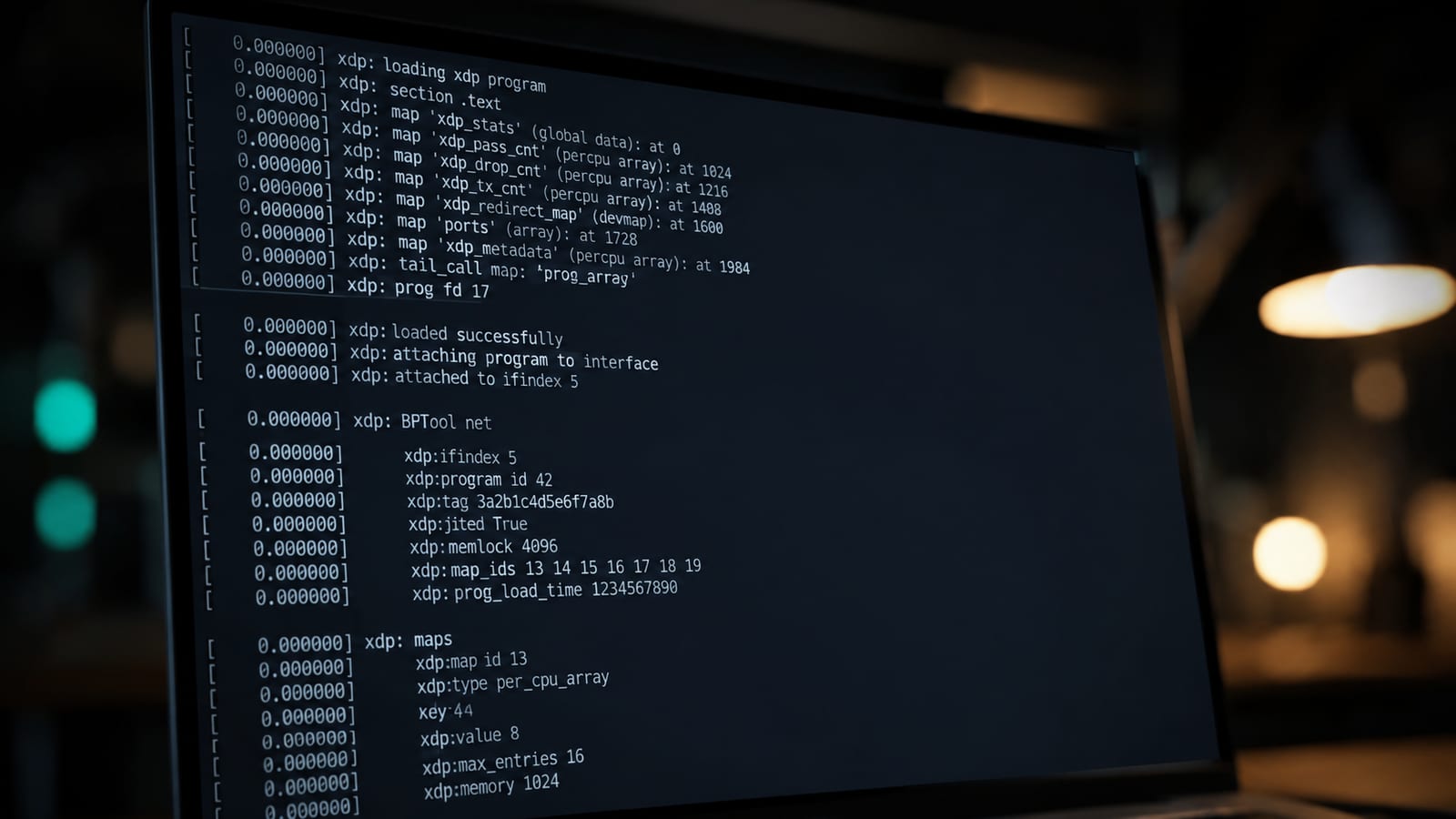
Load and attach XDP programs to network interfaces using bpftool and ip link pinned syntax. Master the two-step process: pin first, then attach to eth0.
A VLAN tag alone cannot stop lateral traffic. Plan segments, configure trunks and access ports, then route inter-VLAN traffic through firewall rules.
